


Why IUL is a bad investment in 2025? If so, pump the brakes, because that financial product may not be the golden ticket it’s always made out to be.
Though some agents sell it as a “tax-free retirement plan” or “low-risk investment with guaranteed growth,” the truth is more complicated and even riskier. Most financial advisors believe that IUL is possibly the worst investment for the average person right now.
So, why is IUL a bad investment in 2025?
In this complete breakdown, we will strip away all the marketing and reveal:
- The reality about how IUL Policies work behind the curtain
- The top 10 IUL bad investment reasons
- Misleading sales pitches that financial advisers object to
- Real-life examples and superior options to IUL
⚠️ Quick Stat:
More than 40% of IUL buyers don’t completely understand the risks they are buying into, according to the National Association of Insurance Commissioners.
💡 What You’ll Learn:
- What all the fuss is about, IUL … and why it doesn’t measure up.
- The money traps most investors can’t see coming.
- Here are some smarter, safer options for building long-term wealth in 2025.
🔍 What Is IUL and Why Is It Marketed as an Investment in 2025?
🤔 What Is Indexed Universal Life Insurance (IUL)?
Indexed Universal Life Insurance (IUL) is a similar hybrid product, with a range of 50% life insurance to 50% investment. It’s intended to provide a death benefit and include a cash value portion that grows according to the performance of a stock market index (such as the S&P 500).
But here’s the catch: You’re not investing in the market. Instead, your returns are capped by the insurer, and your downside is “protected” only in theory.
🧠 How IUL Works (In Simple Terms)
Let’s break it down:
- You pay a premium into the policy.
- A portion is used to cover the cost of insurance, and the other portion goes into a cash value account.
- The account value in that example is linked to an index but subject to caps, participation rates, and fees.
- You can borrow against the cash value, but this comes with interest payments and risks of reducing your death benefit.
Sounds complicated? That’s because it is.
💬 Why Is IUL Often Marketed Like a Smart Investment?
Here is how IUL is aggressively marketed in 2025:
- A “tax-free retirement vehicle”
- A “safe 401(k) and Roth” alternative
- A “way to grow wealth without exposure to market losses”
These pitches exploit fear and confusion about taxes, market fluctuations, and outliving your money.
Yet behind the glitzy brochures and “custom illustrations,” IULs are commonly misunderstood and misused by consumers, which is why they make for a bad investment choice for most people.
🚩 Red Flags You Shouldn’t Ignore
- High commissions are paid to agents to sell IUL.
- Complicated fee schedules that chip away at returns.
- Unlikely predictions that are rarely realised.
💡 A financial product should be simple enough for the average investor to understand. If it takes a 40-page prospectus to explain, that’s a red flag.
— Certified Financial Planner, CFP®
⚠️ 10 Reasons Why IUL Is a Bad Investment in 2025
Here are 10 key reasons why IUL is a bad investment for 2025 and why smart investors are avoiding it:
1. Hidden Fees That Kill Your Returns:
Although sold as a low-risk growth product, the reality is that IUL is full of:
- Cost of insurance charges (COI)
- Administrative fees
- Rider costs
- Surrender charges
💥 Over time, these eat away at your returns and leave you with less than you would have gained with a basic index fund.
2. Complex and Misleading Product Design:
IUL isn’t just difficult to comprehend; it’s created to be hard to understand. Caps, floors, spreads, and participation rates, the average consumer has little understanding of:
- How much money do they earn
- When they can access it
- What will it cost to borrow
If you need a financial dictionary to understand what you’re investing in, it’s probably not the right one.
3. Agents Earn Massive Commissions for Selling It:
IUL is a commission-heavy product. Agents can receive 90–120% of their first year’s premium. That sets up an inherent conflict of interest where your long-term success is not their concern, if it ever was.
4. Capped Growth = Missed Market Upside:
Unlike true index funds, IUL growth is limited, typically somewhere around 8–10%. If the S&P 500 returns 20%? You still only get the cap.
And a few policies have a “spread” that will lower your credited interest even when markets do well.
5. No Guarantees Despite the “Safety” Pitch
IUL policies have been frequently referred to as “guaranteed not to lose money.” But that’s misleading. Here’s why:
- Policy charges still take effect in the down years
- Cash value may decline or vanish
- Massive share declines can cause you to lose coverage
So, yes, you can lose money, but not in a way that is clear up front.
6. Risk of Policy Lapse Due to Rising Premiums:
And the older you are, the more your insurance costs. If you don’t have enough cash value to cover that, you’ll need to pay out-of-pocket … or your policy goes away.
And if you let it lapse? You may very well owe back taxes on your gains.
7. Policy Loans Are Not Free or Risk-Free:
Yes, you may be able to borrow from your IUL’s cash value, but:
- You’ll pay interest
- You risk reducing your death benefit
- If the market does poorly, you may end up owing more than you originally borrowed.
It’s not exactly like borrowing from a savings account.
8. Projected Returns Are Often Unrealistic:
Sales presentations typically look for the bright side of the market. But the real returns are contingent on:
- Caps and participation limits
- Policy expenses
- Volatility over time
The result? Your cash value could be far lower than that.
9. Better, Simpler Alternatives Exist:
Why complicate your retirement when:
- Roth IRAs offer tax-free growth.
- Index funds are long-term and market-selective.
- Term life insurance safeguards your family for a portion of the cost.
In either case, you’re not blending insurance with investment, and that’s a good thing.
10. IUL Isn’t Designed for the Average Investor:
Unless you:
- IUL isn’t for the average investor
- Max out your Roth and 401(k)
- Have a high net worth
- Use a fee-only fiduciary to look at the entirety of your plan
… then IUL probably isn’t for you.
🧠 Bottom Line: These are 10 reasons that demonstrate why IUL is a bad investment for the majority of people in 2025. The risks, costs, and complexity of this product seem excessive for the limited expected return, so rounding to a number like 2% instead of 2.14% is hindered by competition amongst insurance companies and their profit margins, especially given the competition from simple and more transparent competing products.
⚖️ Is IUL a Scam or Just Overhyped? The Grey Area Explained
🤨 Is Indexed Universal Life Insurance (IUL) a Scam?
Let’s get one thing straight: IUL is not a scam, and there is nothing illegal about insurance companies selling these products. But the question becomes much larger: Is IUL really in your financial best interest?
Technically, it’s not a scam. But in 2025, the way IUL is marketed, distorted, and sold to the public raises serious ethical red flags.
💬 Why Some Experts Call IUL “Legalized Deception”
- The problem is not with the product itself; it’s the pitch.
- Salespeople frequently overstate returns and underplay risks.
- Buyers are rarely informed of steep fees and increasing insurance costs.
- Graphs are made on the best-case scenario, not the probable reality of the trading arena.
⚠️ Informed consent is often missing. That’s what makes IUL feel like a scam to many policyholders.
🧩 IUL Is Built on Technical Loopholes and Sales Psychology
Here’s how it works:
- Emotional sales language such as “tax-free retirement,” “guaranteed protection,” and “legacy wealth.”
- Complex language to obviate inquiry (e.g., “option-adjusted spreads” and “participation rates”).
- No clear disclosure of how the cash value is calculated.
🚨 Why Financial Advisors Are Divided on IUL:
No-fee fiduciary advisors (who do not take commissions) are generally against IUL, explaining:
- High risk of policy lapse
- Overpromised, underdelivered returns
- Client confusion and regret
And yet, commission-based insurance agents keep selling IUL as hard as they can because it pays the most.
📉 The Bottom Line: Overhyped, Misunderstood, and Misused
So… is IUL a scam? No. But is it overhyped, overpromoted, and too catalyst-specific for most investors in 2025? Absolutely.
IUL exists in a gray area where something legal isn’t always sound as an investment. For the ordinary investor, it’s nothing more than a bad investment put in fancy brochures and covered by misleading guarantees.

🧨 Common IUL Sales Myths vs. Financial Reality (2025 Edition)
In 2025, indexed universal life insurance is being sold based on hyped-up claims and half-truths. Most buyers will get a well-polished pitch, even if they seldom get the whole story. Let’s dispel the biggest IUL myths with some hard financial facts.
💬 Myth #1: “You’ll Get Tax-Free Retirement Income”
The Pitch: “Grow your cash value tax-deferred, and spend it tax-free in retirement!”
The Reality:
So, the answer is yes, loans from your IUL cash value are not subject to tax, but only if the policy remains in force. If it does (which is more common than you think), you may owe taxes on all gains realized previously.
Worse? You are borrowing against your own money and paying interest for the privilege.
✅ Safer option: With Roth IRAs, you get to take your money out tax-free with no exposure to policy risk or a loan structure.
💬 Myth #2: “You Can Be Your Bank”
The Pitch: “Your cash value whenever you need it. Banks? Taxes? Limits? Ain’t nobody got time for that shit!”
The Reality:
It’s a line favored by financial influencers, but it is misleading. In reality:
- Instead, you’re borrowing your death benefit, not saving your money
- Loans will decrease the cash value and the death benefit.
- And the interest adds up, while the market would have underperformed.
So, you’re not becoming a bank — you’re paying for the privilege of using your own money, on a string.
💬 Myth #3: “You’ll Get Guaranteed Market Growth Without the Risk”
The Pitch: “Ride the upside of the market; participate but not speculate.”
The Reality:
What they don’t tell you is:
- Caps restrain your max gains (typically 8-10%)
- Contributory rates can lower the amount you are credited.
- In down or flat markets, there are still fees, which eat into your cash value.”
⚠️ Market-linked doesn’t mean market-equivalent. You’re trading transparency for complexity.
💬 Myth #4: “It’s Better Than a 401(k) or IRA”
The Pitch: “401(k)s are taxed and in the market—IUL is safe and tax-free!”
The Reality:
This is pure misdirection. Though 401(k)s and IRAs have tax considerations, they also have:
- Lower fees
- Simpler rules
- Better long-term returns
- Fiduciary protection
And, in a nice geographic touch, you manage your investments very directly, not through a murky insurance contract.
🚩 Key Takeaway: Don’t Fall for the Marketing:
The sales playbook for the IUL is larded with delicious-sounding language: “guaranteed,” “tax-free,” “safe.” But these terms are frequently flashed out of context, or buried in fine print that most buyers don’t even read until it’s too late.
🧠And if IULs were so great, why aren’t fiduciary advisors recommending them more frequently?
📉 Real-Life Examples: When IUL Goes Wrong
Expectations of steady growth and tax-free income are what many policyholders buy Indexed Universal Life Insurance for. But in the real world, that’s often not how things work. Here are actual stories of how IULs didn’t live up to the sales pitch—and why IUL is a bad investment for most.
😟 Case Study #1: The Retiree with a Lapsed Policy
Who: 58-year-old small business owner
The Pitch: “Retirement income tax-free for life”
The Outcome:
- Contributed for 10 years, but the market returns were too low
- Increased policy loans and loan interest outstripped growth
- Policy lapsed at 68, costing us a huge tax bill on all past gains
👉 This retiree felt like she’d be set for life — it wasn’t that simple, thanks to a zero death benefit and an unwanted IRS bill in retirement.
💸 Case Study #2: The Overpromised, Underdelivered Growth
Who: 40-year-old tech employee
The Pitch: “10–12% per year annual growth without market risk”
The Outcome:
- The average interest earned was only 4.3% over 7 years
- Fees are deducted thousands annually
- Discovered I could have gotten better returns from a cheap dumb S&P 500 index fund.
👉 What had seemed like a clever hybrid strategy was slow-growth with high drag of ongoing charges.
📉 Case Study #3: Can’t Afford to Keep It, Can’t Afford to Cancel It
Who: 35-year-old couple with kids
The Pitch: “Great for college planning & legacy building.”
The Outcome:
- Couldn’t afford increasing premiums
- It had a surrender value of less than half of what they had paid in.
- The other issue was that canceling it would result in enormous losses.
👉 Their financial advisor later described it as “one of the most expensive mistakes families make.”
⚠️ The Common Denominators Across All Cases:
- Overpromised market returns.
- The cost of insurance and policy fees is underestimated.
- There was no flexibility if you wanted to make a change after your life or financial circumstances changed.
- Lack of fiduciary direction at the time of purchase.
📌 Keep this in mind: These are not isolated horror stories. Many policyholders suffer the damage quietly, by either canceling policies long before they need them or realizing less in expected benefits down the line.
🎯 Final Thought of This Section
Indexed Universal Life policies are complex, expensive, and quite sensitive to long-term scenarios. Real-world evidence consistently shows that it falls short of expectations, particularly in areas like retirement and wealth-building.
🤑 Why Do So Many Agents Push IULs? (Follow the Commissions)
💼 Ever Wonder Why Your Advisor Keeps Pushing IUL?
If you’ve been offered an Indexed Universal Life (IUL) policy, you’re in good company. Far too many insurance salesmen aggressively sell such products, and by even some financial advisers. But what’s the story behind the sales pitch?
Spoiler: It’s not always about your best interest — it’s frequently about theirs.
💰 IUL Commissions Are Shockingly High
IULs also give agents large lump-sum payments up front, relatively speaking, compared to other financial products:
- Brokers may be paid 50% to 90% of your first-year premium
- On a $10,000/year policy, that could mean $5,000-$9,000 in commission
- Some agents also get residual trail commissions for the life of the policy.
👉 This is why IULs are so much more profitable than selling term life, index funds, or annuities.
🎭 The Hidden Conflict of Interest
Many are not fiduciaries — they are not legally obligated to act in your best interest. Instead, they may:
- Recommend IUL’s instead of cheaper options such as term life + investments
- De-emphasize the risks (e.g. cost increase, policy lapse)
- Focus on benefits that are supported by best-case projections, not real-world averages
📉 This conflict of interest is one of the main reasons IUL is a bad investment for the average person.
🤔 What They Often Don’t Tell You
- If you can’t afford those premiums, you can lose your policy and your cash value.
- Growth is limited by an index (e.g., 10%), but you still incur significant fees during flat years.
- You could end up with less in your pocket than you put in, even if all that seemingly tax-free wealth came as promised.
✅ Red Flags to Watch for in a Sales Pitch
- “It’s an alternative retirement plan.” → 🚩 It is not if it’s life insurance with investment wrappers.
- “You can make 12% returns” → 🚩 Indexed crediting is subject to a cap and does not include dividends.
- “It’s risk-free” → 🚩 Fees, market caps, interest rate movements all present real risks.
- “Better than 401(k)s” → 🚩 Few experience better long-term performance.
📌 Bottom Line:
The commission structure drives behavior. The reason many agents pitch IULs isn’t because they’re the best solution, but because they’re the most lucrative for the seller. And that’s one of the biggest reasons why IUL is a terrible investment for most people.
🛑 What Are the Hidden Risks of IUL Policies in 2025?
🔍 Are You Aware of the Fine Print in Your IUL Policy?
Many people purchase Indexed Universal Life insurance believing it’s a safe, tax-free investment vehicle that comes with guaranteed growth.
But here’s the uncomfortable truth:
IULs often come with numerous hidden risks that can gradually erode your money over time.
And in 2025, those risks will be only sharper.
⚠️ Hidden IUL Risks You Need to Know
Why is IUL a bad investment for 99% people, even more so in the current economic climate?
1. Policy Lapse Danger:
- Your policy can lapse if your cash value underperforms or you stop making premium payments.
- Both your insurance protection and the money invested will be lost.
- If the lapse occurs after 59½, you could also face tax penalties.
2. Rising Cost of Insurance (COI)
- The COI keeps growing as you get older.
- And by the time you reach your 50s, 60s, or beyond, you may be shelling out thousands each year simply to keep the policy active.
- This rising cost can eat away your cash value, even in years when the market is performing well.
3. Cap Rates Limit Your Growth
- IULs have cap rates (think, 9%–11%) that reduce the amount of the market’s upside you receive.
- If the market returns 15% and your cap is 10%, you take home 10% — but you still pay the full fees.
- In years of little to no return, such as flat years, fees can erode your cash value.
4. Participation Rates Are Not Guaranteed
- The rates of participation dictate what share of the market gain you receive.
- Many insurers have reduced these rates as a result of market fluctuations in 2025.
- Some policies credit you only 70% or even less of the index growth, further reducing your potential gains.
5. Unpredictable Interest Rate Environment
- IUL returns are somewhat tied to the performance of interest rates.
- Beginning in 2025, rate adjustments can affect cap rates and crediting formulas, so your growth could be even more of a question mark.
🧨 Real-Life Scenario: How Your IUL Could Collapse
Imagine this:
- You purchase an IUL in 2025, paying $6,000 in annual premiums
- 2–3 years – Market goes sideways, with no or flat gain.
- COI increases with age
- Cap rates drop to 8%
- You can’t be paying a premium in Year 5
- Your policy lapses → You lose thousands of dollars in cash value, and the death benefit goes out the window.
That isn’t uncommon — it’s a regular occurrence.
🔎 Why These Risks Are Often Downplayed
Most agents concentrate on “projected returns”, creating illustrations based on hunky-dory scenarios (like 7% growth) every year. Only the real world doesn’t work like that.
So, even slight variations from these assumptions. A lousy year for the markets, the failure to pay a premium or make a contribution, can set off a cascade of effects.
✅ Bottom Line:
Add in the increasing costs, capped returns, and policy lapse risk, and the IUL is shaping up to be a high-maintenance, low-transparency product. And so it’s a big reason why IUL is a terrible investment for people who are looking for steady, low-cost, long-term growth.
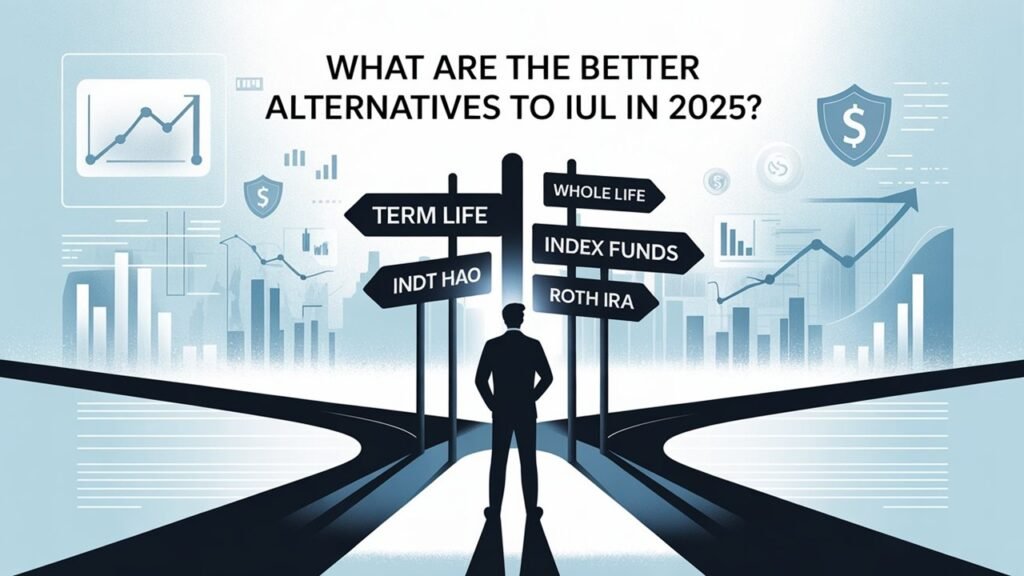
💼 What Are the Better Alternatives to IUL in 2025?
💡 Looking for Better Returns with Fewer Surprises?
So if you’re starting to figure out why IUL is a terrible investment — with secret fees, capped returns, and a high level of lapse risk — you’re probably also asking yourself:
“What should I be investing in instead?”
Here are some honest alternatives that are doing better than IULs in 2025:
🏆 Top IUL Alternatives in 2025
1. Roth IRA (Individual Retirement Account)
- Roth IRA (Individual Retirement Account)
- Growth is tax-free, and so are withdrawals after the age of 59½
- Transparent charges, no capping, and no participation rates
- Buy low-cost index funds such as the S&P 500
- Great for long-term growth and retirement savings
2. Term Life Insurance + Investing the Difference
- Purchase a term life policy (10-30 years) for the death benefit only protection
- Put the savings into:
- ETFs
- Mutual funds
- Brokerage accounts
- Frequently better than IUL over 20+ years
3. 401(k) or Solo 401(k) Plans
- Great for individuals earning a high income or owners of businesses
- Employer match = instant return
- No strings or hidden fees
- Direct investments in mixed mutual funds or target-date portfolios
4. Whole Life (for Specific Use Cases)
- STUD service only, but guaranteed growth and level premiums
- Best for: Those with an ultra-high net worth who need estate planning or tax sheltering
- More transparency than IUL, but not for everyone.
📊 Performance Snapshot: IUL vs. Roth IRA (2025)
| Feature | IUL | Roth IRA |
| Growth Potential | Capped (8–11%) | Uncapped (market returns) |
| Transparency | Low (complex structure) | High (you control investments) |
| Tax Benefits | Tax-deferred | Tax-free |
| Liquidity | Complex access rules | Easy penalty-free after 59½ |
| Fees | High (COI, admin, surrender) | Low (ETF expense ratios <0.10%) |
❗ Who Should Still Consider IUL?
Very few people.
But find out if it may make sense if:
- Max out other retirement accounts
- Have a high disposable income
- Want a permanent death benefit and some tax-deferred growth
- Consult with a true fiduciary (non-commission-based)
But for most people?
That would be the choice to keep it simple, stay diversified, and avoid overly complicated insurance products masquerading as investments.
✅ Final Thought:
If you’re looking for growth, flexibility, and transparency, IUL is not the tool.
Opting for strategies like Roth IRAs, index funds, or term+invest will likely yield better returns and fewer regrets, particularly in 2025 and beyond.
❓FAQs: Is IUL Still Worth It in 2025?
❓Is term or IUL a good in investment in 2025?
No, not for most people.
Although it provides tax-deferred growth and permanent life insurance coverage, sky-high fees, capped returns, and a convoluted structure make it a poor choice compared to more transparent, higher-yielding alternatives such as Roth IRAs or index funds.
❓What is wrong with IUL?
IUL is sold with ridiculous return promises. In truth:
Expansion is constrained or mitigated by participation rates.
Fees can eat away at your cash value.
It’s hard to figure out and easy to bungle.
As well, policy lapses may mean that you end up with nothing after paying for years.
❓Are the benefits of IUL nonexistent?
Yes, but only in specific cases:
Tax-deferred growth
Flexible premiums
Permanent death benefit
Still, these are benefits that come with high costs and risk, and there are often far better alternatives, particularly for long-term wealth building.
❓Can you lose money with IUL?
Yes. Suppose you don’t fully fund the policy. In that case, you stop paying premiums or you miss the policy requirements, your cash value can disappear, and the policy can lapse, leaving you without insurance.
❓What’s the best alternative to IUL in 2025?
For most people:
Roth IRA for tax-free growth and retirement.
Affordable coverage through term life insurance.
Those are index funds or ETFs for easy, no-nonsense long-term investing.
These are more pliable, clear, and cost-effective, well-organized, and stable than an IUL.
❓Who should avoid IUL?
You should avoid IUL if:
You want clear, low-cost investing
You’re not comfortable with complex insurance structures
You need money and a lot of it, or you’re on a tight budget, or in need of liquidity
You Are Not Using Your Roth Ira, 401(k), Or Hsa To The Max
❓Does IUL offer guaranteed returns?
No. Although IUL shields you from direct market losses, its returns are not guaranteed and are limited by caps, fees, and policy performance. With every step of the process, you will get a smaller return than was promised in the sales pitch.

![What Can I Do with a Business Degree [Beginner’s Guide to Career Options]](https://finverrahq.com/wp-content/uploads/2025/07/What-Can-I-Do-with-a-Business-Degree-Beginners-Guide-to-Career-Options-150x150.jpeg)



Pingback: Best Affordable Health Insurance for Small Nonprofits [2025]